> ## Documentation Index
> Fetch the complete documentation index at: https://docs.runmaestro.ai/llms.txt
> Use this file to discover all available pages before exploring further.
# Spec-Kit Commands
> Structured specification workflow for AI-assisted development using GitHub's spec-kit methodology.
Spec-Kit is a structured specification workflow from [GitHub's spec-kit project](https://github.com/github/spec-kit) that helps teams create clear, actionable specifications before implementation. Maestro bundles these commands and you can check for updates manually via Settings.
 ## Spec-Kit vs. Wizard
Maestro offers two paths to structured development:
| Feature | Spec-Kit | Onboarding Wizard |
| -------------------- | ------------------------------------------ | -------------------------------- |
| **Approach** | Manual, command-driven workflow | Guided, conversational flow |
| **Best For** | Experienced users, complex projects | New users, quick setup |
| **Output** | Constitution, specs, tasks → Auto Run docs | Phase 1 Auto Run document |
| **Control** | Full control at each step | Streamlined, opinionated |
| **Learning Curve** | Moderate | Low |
| **Storage Location** | `.specify/` directory in project root | `.maestro/playbooks/Initiation/` |
**Use Spec-Kit when:**
* You want fine-grained control over specification phases
* You're working on complex features requiring detailed planning
* You prefer explicit command-driven workflows
* You want to create reusable constitutions and specifications
**Use the Wizard when:**
* You're starting a new project from scratch
* You want to get up and running quickly
* You prefer conversational, guided experiences
Both approaches ultimately produce markdown documents for Auto Run execution.
## Viewing & Managing Commands
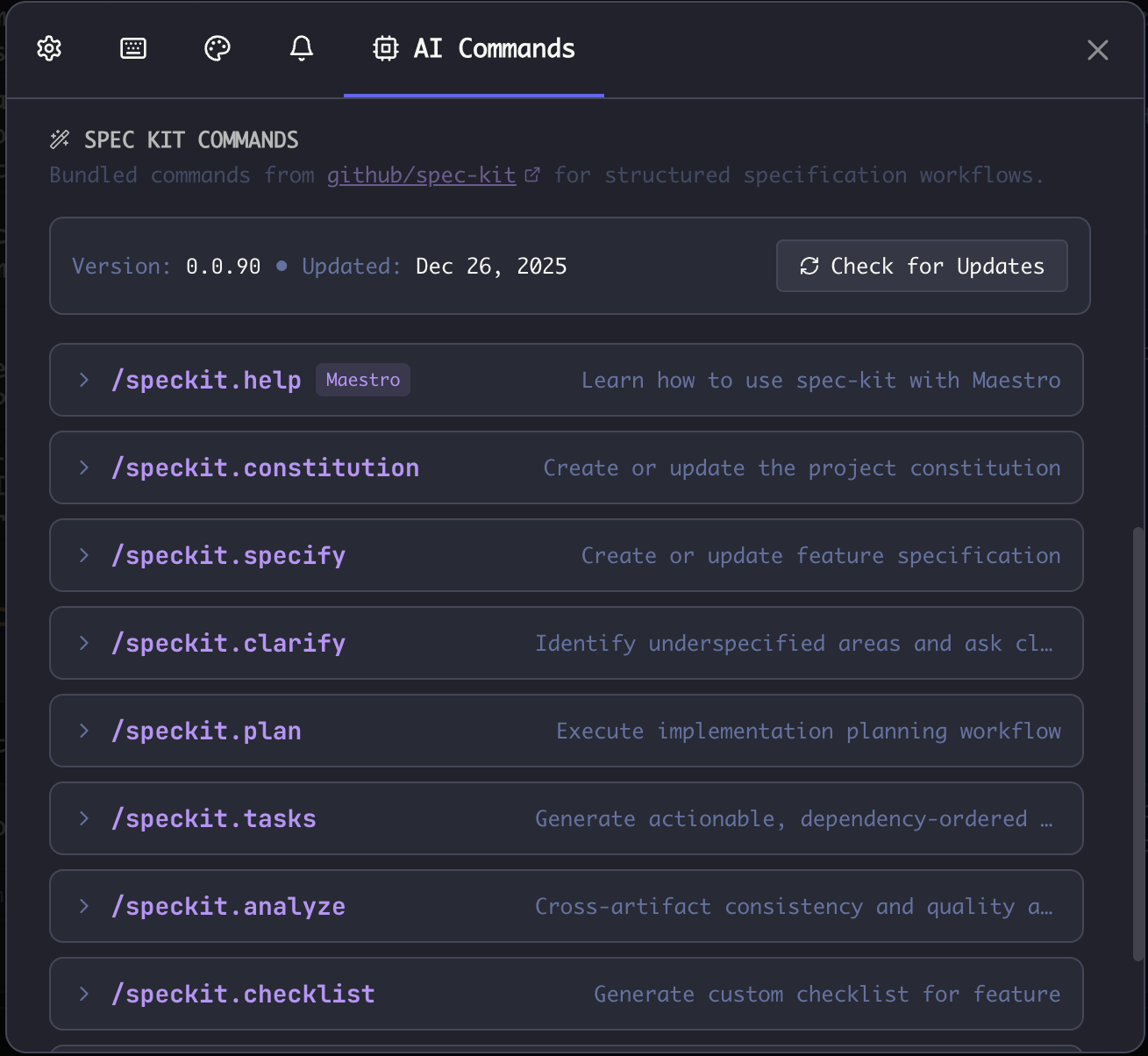
Access Spec-Kit commands via **Settings → AI Commands** tab. Here you can:
* **View all commands** - See descriptions and expand to view full prompts
* **Check for Updates** - Manually pull the latest prompts from GitHub releases
* **Edit prompts** - Customize any command (modifications are preserved across updates)
* **Reset to Default** - Restore a modified prompt to the bundled version
Commands marked with a Maestro badge (`/speckit.help`, `/speckit.implement`) are Maestro-specific and not updated from upstream.
## Prerequisites
Maestro does not automatically create the folder structure or scripts required to run Spec-Kit. You’ll need to set these up manually.
Get started: Follow the instructions in the “Get Started” section of the [GitHub Spec-Kit repository](https://github.com/github/spec-kit?tab=readme-ov-file#1-install-specify-cli):
```bash theme={"theme":"dracula"}
# Create new project
specify init
# Or initialize in existing project
specify init . --ai claude
# or
specify init --here --ai claude
```
## Core Workflow (Recommended Order)
### 1. `/speckit.constitution` - Define Project Principles
Start here to establish your project's foundational values, constraints, and guidelines. The constitution guides all subsequent specifications and ensures consistency across features.
**Creates:** `.specify/memory/constitution.md` - A versioned constitution document with core principles, technical constraints, team conventions, and governance rules.
### 2. `/speckit.specify` - Create Feature Specification
Define the feature you want to build with clear requirements, acceptance criteria, and boundaries. Creates a new numbered Git branch and initializes the spec directory structure.
**Creates:** `specs/-/spec.md` - A detailed feature specification with scope, functional requirements, user scenarios, and success criteria. Also creates a `checklists/requirements.md` validation checklist.
### 3. `/speckit.clarify` - Identify Gaps
Review your specification for ambiguities, missing details, and edge cases. The AI asks up to 5 targeted clarification questions sequentially, encoding answers directly into the spec.
**Updates:** `specs/-/spec.md` - Adds a `## Clarifications` section with session-dated answers, and propagates clarifications to relevant spec sections.
**Tip:** Run `/speckit.clarify` multiple times - each pass catches different gaps. Use early termination signals ("done", "good", "no more") to stop questioning.
### 4. `/speckit.plan` - Implementation Planning
Convert your specification into a high-level implementation plan. Includes technical context, constitution compliance checks, and multi-phase design workflow.
**Creates:** Multiple artifacts in the feature directory:
* `plan.md` - Implementation plan with phases and milestones
* `research.md` - Resolved unknowns and technology decisions (Phase 0)
* `data-model.md` - Entities, fields, and relationships (Phase 1)
* `contracts/` - API contracts in OpenAPI/GraphQL format (Phase 1)
* `quickstart.md` - Getting started guide (Phase 1)
### 5. `/speckit.tasks` - Generate Tasks
Break your plan into specific, actionable tasks with dependencies clearly mapped. Tasks are organized by user story and structured in phases.
**Creates:** `specs/-/tasks.md` - A dependency-ordered task list with:
* **Phase 1:** Setup (project initialization)
* **Phase 2:** Foundational (blocking prerequisites)
* **Phase 3+:** User stories in priority order (P1, P2, P3...)
* **Final Phase:** Polish & cross-cutting concerns
Each task has an ID (T001, T002...), optional `[P]` marker for parallelizable tasks, and `[US#]` labels linking to user stories.
### 6. `/speckit.implement` - Execute with Auto Run
**Maestro-specific command.** Converts your tasks into Auto Run documents that Maestro can execute autonomously. This bridges spec-kit's structured approach with Maestro's multi-agent capabilities.
**Creates:** Markdown documents in `.maestro/playbooks/` with naming pattern:
```
.maestro/playbooks/SpecKit--Phase-01-[Description].md
.maestro/playbooks/SpecKit--Phase-02-[Description].md
```
Each phase document is self-contained, includes Spec Kit context references, preserves task IDs (T001, T002...) and user story markers (\[US1], \[US2]) for traceability.
## Analysis & Quality Commands
### `/speckit.analyze` - Cross-Artifact Analysis
Verify consistency across your constitution, specifications, and tasks. Performs a read-only analysis that catches:
* **Duplications** - Near-duplicate requirements
* **Ambiguities** - Vague adjectives lacking measurable criteria
* **Underspecification** - Missing acceptance criteria or undefined components
* **Constitution violations** - Conflicts with project principles (always CRITICAL severity)
* **Coverage gaps** - Requirements without tasks, or orphaned tasks
**Outputs:** A structured Markdown report with severity ratings (Critical/High/Medium/Low), coverage metrics, and suggested next actions. Does not modify any files.
### `/speckit.checklist` - Requirements Quality Validation
Generate "unit tests for requirements" - checklists that validate the *quality* of your requirements, not the implementation. Each checklist item tests whether requirements are complete, clear, consistent, and measurable.
**Creates:** `specs/-/checklists/.md` (e.g., `ux.md`, `api.md`, `security.md`)
Example items:
* "Are visual hierarchy requirements defined with measurable criteria?" \[Completeness]
* "Is 'fast loading' quantified with specific timing thresholds?" \[Clarity]
* "Are error handling requirements defined for all API failure modes?" \[Gap]
**Note:** This is NOT for QA testing implementation - it validates that requirements are well-written before implementation begins.
### `/speckit.taskstoissues` - Export to GitHub Issues
Convert your tasks directly into GitHub Issues.
**Requirements:**
* `gh` CLI installed and authenticated
* GitHub MCP server tool (`github/github-mcp-server/issue_write`)
* Remote must be a GitHub URL
**Caution:** Only creates issues in the repository matching your Git remote - will refuse to create issues elsewhere.
## Getting Help
Run `/speckit.help` to get an overview of the workflow and tips for best results. This Maestro-specific command provides:
* Command overview with recommended workflow order
* Integration tips for Auto Run
* Links to upstream documentation
## Updating Commands
Spec-Kit prompts can be updated from the [GitHub spec-kit repository](https://github.com/github/spec-kit) releases:
1. Open **Settings → AI Commands**
2. Click **Check for Updates** button
3. Latest prompts are downloaded from the most recent GitHub release
4. Your custom modifications are preserved - edited prompts are not overwritten
The version number (e.g., `v0.0.90`) and last refresh date are shown at the top of the Spec Kit Commands section.
**Note:** Custom Maestro commands (`/speckit.help`, `/speckit.implement`) are bundled with Maestro and not updated from upstream.
## Tips for Best Results
* **Start with constitution** - Even for small projects, defining principles helps maintain consistency and catch violations early
* **Iterate on specifications** - Use `/speckit.clarify` multiple times to refine your spec; accept recommended answers for faster iteration
* **Keep specs focused** - One feature per specification cycle works best; use numbered branches (`1-feature-name`, `2-other-feature`)
* **Review before implementing** - Use `/speckit.analyze` after `/speckit.tasks` to catch issues before coding
* **Validate requirements first** - Use `/speckit.checklist` to verify requirements are clear and complete before implementation
* **Leverage parallelism** - With Maestro, run multiple spec-kit workflows simultaneously across different agents using worktrees
## Spec-Kit vs. Wizard
Maestro offers two paths to structured development:
| Feature | Spec-Kit | Onboarding Wizard |
| -------------------- | ------------------------------------------ | -------------------------------- |
| **Approach** | Manual, command-driven workflow | Guided, conversational flow |
| **Best For** | Experienced users, complex projects | New users, quick setup |
| **Output** | Constitution, specs, tasks → Auto Run docs | Phase 1 Auto Run document |
| **Control** | Full control at each step | Streamlined, opinionated |
| **Learning Curve** | Moderate | Low |
| **Storage Location** | `.specify/` directory in project root | `.maestro/playbooks/Initiation/` |
**Use Spec-Kit when:**
* You want fine-grained control over specification phases
* You're working on complex features requiring detailed planning
* You prefer explicit command-driven workflows
* You want to create reusable constitutions and specifications
**Use the Wizard when:**
* You're starting a new project from scratch
* You want to get up and running quickly
* You prefer conversational, guided experiences
Both approaches ultimately produce markdown documents for Auto Run execution.
## Viewing & Managing Commands
Access Spec-Kit commands via **Settings → AI Commands** tab. Here you can:
* **View all commands** - See descriptions and expand to view full prompts
* **Check for Updates** - Manually pull the latest prompts from GitHub releases
* **Edit prompts** - Customize any command (modifications are preserved across updates)
* **Reset to Default** - Restore a modified prompt to the bundled version
Commands marked with a Maestro badge (`/speckit.help`, `/speckit.implement`) are Maestro-specific and not updated from upstream.
## Prerequisites
Maestro does not automatically create the folder structure or scripts required to run Spec-Kit. You’ll need to set these up manually.
Get started: Follow the instructions in the “Get Started” section of the [GitHub Spec-Kit repository](https://github.com/github/spec-kit?tab=readme-ov-file#1-install-specify-cli):
```bash theme={"theme":"dracula"}
# Create new project
specify init
# Or initialize in existing project
specify init . --ai claude
# or
specify init --here --ai claude
```
## Core Workflow (Recommended Order)
### 1. `/speckit.constitution` - Define Project Principles
Start here to establish your project's foundational values, constraints, and guidelines. The constitution guides all subsequent specifications and ensures consistency across features.
**Creates:** `.specify/memory/constitution.md` - A versioned constitution document with core principles, technical constraints, team conventions, and governance rules.
### 2. `/speckit.specify` - Create Feature Specification
Define the feature you want to build with clear requirements, acceptance criteria, and boundaries. Creates a new numbered Git branch and initializes the spec directory structure.
**Creates:** `specs/-/spec.md` - A detailed feature specification with scope, functional requirements, user scenarios, and success criteria. Also creates a `checklists/requirements.md` validation checklist.
### 3. `/speckit.clarify` - Identify Gaps
Review your specification for ambiguities, missing details, and edge cases. The AI asks up to 5 targeted clarification questions sequentially, encoding answers directly into the spec.
**Updates:** `specs/-/spec.md` - Adds a `## Clarifications` section with session-dated answers, and propagates clarifications to relevant spec sections.
**Tip:** Run `/speckit.clarify` multiple times - each pass catches different gaps. Use early termination signals ("done", "good", "no more") to stop questioning.
### 4. `/speckit.plan` - Implementation Planning
Convert your specification into a high-level implementation plan. Includes technical context, constitution compliance checks, and multi-phase design workflow.
**Creates:** Multiple artifacts in the feature directory:
* `plan.md` - Implementation plan with phases and milestones
* `research.md` - Resolved unknowns and technology decisions (Phase 0)
* `data-model.md` - Entities, fields, and relationships (Phase 1)
* `contracts/` - API contracts in OpenAPI/GraphQL format (Phase 1)
* `quickstart.md` - Getting started guide (Phase 1)
### 5. `/speckit.tasks` - Generate Tasks
Break your plan into specific, actionable tasks with dependencies clearly mapped. Tasks are organized by user story and structured in phases.
**Creates:** `specs/-/tasks.md` - A dependency-ordered task list with:
* **Phase 1:** Setup (project initialization)
* **Phase 2:** Foundational (blocking prerequisites)
* **Phase 3+:** User stories in priority order (P1, P2, P3...)
* **Final Phase:** Polish & cross-cutting concerns
Each task has an ID (T001, T002...), optional `[P]` marker for parallelizable tasks, and `[US#]` labels linking to user stories.
### 6. `/speckit.implement` - Execute with Auto Run
**Maestro-specific command.** Converts your tasks into Auto Run documents that Maestro can execute autonomously. This bridges spec-kit's structured approach with Maestro's multi-agent capabilities.
**Creates:** Markdown documents in `.maestro/playbooks/` with naming pattern:
```
.maestro/playbooks/SpecKit--Phase-01-[Description].md
.maestro/playbooks/SpecKit--Phase-02-[Description].md
```
Each phase document is self-contained, includes Spec Kit context references, preserves task IDs (T001, T002...) and user story markers (\[US1], \[US2]) for traceability.
## Analysis & Quality Commands
### `/speckit.analyze` - Cross-Artifact Analysis
Verify consistency across your constitution, specifications, and tasks. Performs a read-only analysis that catches:
* **Duplications** - Near-duplicate requirements
* **Ambiguities** - Vague adjectives lacking measurable criteria
* **Underspecification** - Missing acceptance criteria or undefined components
* **Constitution violations** - Conflicts with project principles (always CRITICAL severity)
* **Coverage gaps** - Requirements without tasks, or orphaned tasks
**Outputs:** A structured Markdown report with severity ratings (Critical/High/Medium/Low), coverage metrics, and suggested next actions. Does not modify any files.
### `/speckit.checklist` - Requirements Quality Validation
Generate "unit tests for requirements" - checklists that validate the *quality* of your requirements, not the implementation. Each checklist item tests whether requirements are complete, clear, consistent, and measurable.
**Creates:** `specs/-/checklists/.md` (e.g., `ux.md`, `api.md`, `security.md`)
Example items:
* "Are visual hierarchy requirements defined with measurable criteria?" \[Completeness]
* "Is 'fast loading' quantified with specific timing thresholds?" \[Clarity]
* "Are error handling requirements defined for all API failure modes?" \[Gap]
**Note:** This is NOT for QA testing implementation - it validates that requirements are well-written before implementation begins.
### `/speckit.taskstoissues` - Export to GitHub Issues
Convert your tasks directly into GitHub Issues.
**Requirements:**
* `gh` CLI installed and authenticated
* GitHub MCP server tool (`github/github-mcp-server/issue_write`)
* Remote must be a GitHub URL
**Caution:** Only creates issues in the repository matching your Git remote - will refuse to create issues elsewhere.
## Getting Help
Run `/speckit.help` to get an overview of the workflow and tips for best results. This Maestro-specific command provides:
* Command overview with recommended workflow order
* Integration tips for Auto Run
* Links to upstream documentation
## Updating Commands
Spec-Kit prompts can be updated from the [GitHub spec-kit repository](https://github.com/github/spec-kit) releases:
1. Open **Settings → AI Commands**
2. Click **Check for Updates** button
3. Latest prompts are downloaded from the most recent GitHub release
4. Your custom modifications are preserved - edited prompts are not overwritten
The version number (e.g., `v0.0.90`) and last refresh date are shown at the top of the Spec Kit Commands section.
**Note:** Custom Maestro commands (`/speckit.help`, `/speckit.implement`) are bundled with Maestro and not updated from upstream.
## Tips for Best Results
* **Start with constitution** - Even for small projects, defining principles helps maintain consistency and catch violations early
* **Iterate on specifications** - Use `/speckit.clarify` multiple times to refine your spec; accept recommended answers for faster iteration
* **Keep specs focused** - One feature per specification cycle works best; use numbered branches (`1-feature-name`, `2-other-feature`)
* **Review before implementing** - Use `/speckit.analyze` after `/speckit.tasks` to catch issues before coding
* **Validate requirements first** - Use `/speckit.checklist` to verify requirements are clear and complete before implementation
* **Leverage parallelism** - With Maestro, run multiple spec-kit workflows simultaneously across different agents using worktrees