
Overview
SSH Remote Execution wraps agent commands in SSH, executing them on a configured remote host while streaming output back to Maestro. Your local Maestro instance remains the control center, but the AI agent runs remotely. Use cases:- Run agents on a powerful cloud VM with more CPU/RAM
- Access tools or SDKs installed only on specific servers
- Work with codebases that require particular OS or architecture
- Execute agents in secure/isolated environments
- Coordinate multiple agents across different machines in Group Chat
- Run Auto Run playbooks on remote projects
Configuring SSH Remotes
Adding a Remote Host
- Open Settings (
Cmd+,/Ctrl+,) - Navigate to the SSH Hosts tab
- Click Add SSH Remote
- Configure the connection:
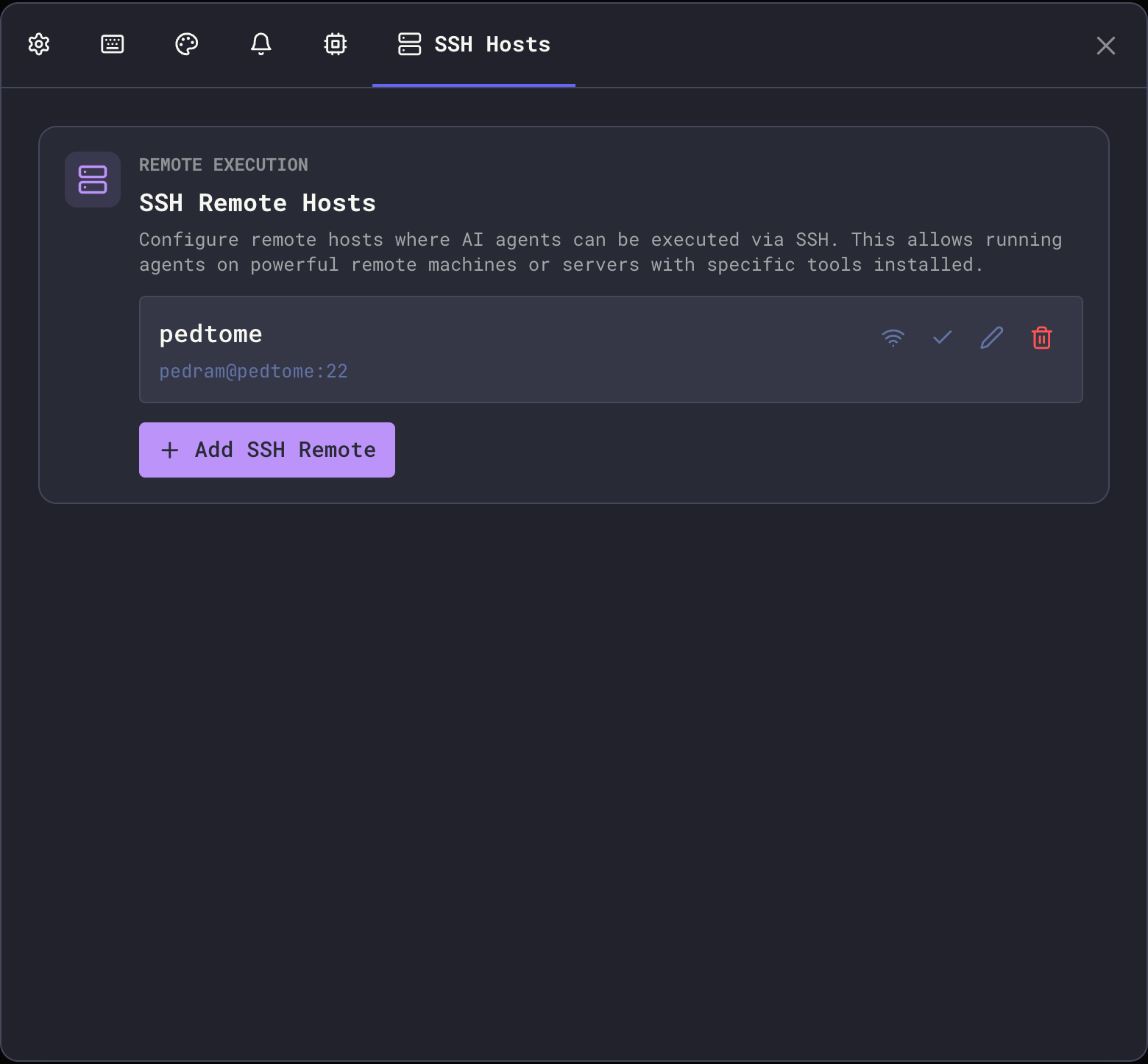
- Click Test Connection to verify connectivity
- Click Save to store the configuration
Using SSH Config File
Maestro can import connection settings from your~/.ssh/config file, making setup faster and more consistent with your existing SSH workflow.
Importing from SSH Config
When adding a new remote, Maestro automatically detects hosts defined in your SSH config:- Click Add SSH Remote
- If SSH config hosts are detected, you’ll see an Import from SSH Config dropdown
- Select a host to auto-fill settings from your config
- The form shows “Using SSH Config” indicator when importing
How It Works
When using SSH config mode:- Host becomes the SSH config Host pattern (e.g.,
dev-serverinstead of192.168.1.100) - Username and Private Key Path become optional - SSH inherits them from your config
- Port defaults to your config’s value (only sent to SSH if overriding a non-default port)
- You can still override any field to customize the connection
~/.ssh/config:
- Select “dev-server” from the dropdown
- Leave username/key fields empty (inherited from config)
- Optionally override specific settings
- Benefit from advanced features like
ProxyJumpfor bastion hosts
Field Labels
When using SSH config mode, field labels indicate which values are optional:- Username (optional) - leave empty to use SSH config’s
User - Private Key Path (optional) - leave empty to use SSH config’s
IdentityFile
Clearing SSH Config Mode
To switch back to manual configuration:- Click the × button next to “Using SSH Config” indicator
- Fill in all required fields manually
SSH Options (Advanced)
The SSH Options section in the remote’s dialog holds extrassh -o KEY=VALUE
pairs. Each one is passed straight to the ssh command Maestro runs, on top of
its own defaults.
Reach for it when the host is not reachable by a plain ssh user@host:
A command-line
-o outranks ~/.ssh/config, so this section is also the only
place Maestro’s own defaults can be changed. If a remote works from your
terminal but fails in Maestro, a default is usually why - ConnectTimeout=10
in particular is short for a tunnel that has to bootstrap a relay before it can
connect.
RequestTTY is reserved and cannot be set here. Maestro derives it per command
from whether the agent speaks stream-json, and a forced TTY injects terminal
control sequences that corrupt that stream.
Switching an entry off
The eye button beside a row switches that option (or environment variable) off without deleting it. The value stays in the dialog, struck through and dimmed, and comes back the moment you switch it on again - so testing whether aProxyCommand is the reason a host stopped answering does not mean pasting the
string into a scratch file first.
A switched-off entry is never passed to ssh. It is kept in a separate list
that nothing but this dialog reads, which is also why a broken entry can be
parked and saved: only live entries are validated, so an option you cannot get
working today does not block the rest of the remote.
The same options are reachable from the CLI, which is how an agent can set up a
remote for you:
Example: a tailcat tunnel
Thecreate-ssh-remote call above is a working tailcat
setup. Two of its options are there on purpose:
HostKeyAlias. With aProxyCommand,sshfiles the host key inknown_hostsunder whatever--hostsays. If that is the machine’s LAN name or address, the tunnelled entry collides with the direct one andsshrefuses the connection as a changed host key. A stable alias gives the tunnel its own entry.ConnectTimeout=45. tailcat has to bootstrap a relay before it can connect, which regularly takes longer than Maestro’s default 10 seconds.
tailcat serve running under
launchd or systemd with KeepAlive (or Restart=always). It proxies into the
real sshd, so authorized_keys still does the authentication:
Connection Testing
Before saving, you can test your SSH configuration:- Basic test: Verifies SSH connectivity and authentication
- Agent test: Checks if the AI agent command is available on the remote host
Setting a Global Default
Click the checkmark icon next to any remote to set it as the global default. When set:- The “Default” badge appears next to the remote name
- The default remote is highlighted in selection dropdowns
- New sessions still require explicit selection - the default serves as a visual indicator of your preferred remote
The global default is a convenience marker, not an automatic setting. Each session must explicitly select an SSH remote via the “SSH Remote Execution” dropdown in the New Agent dialog or session configuration.
Per-Session Configuration
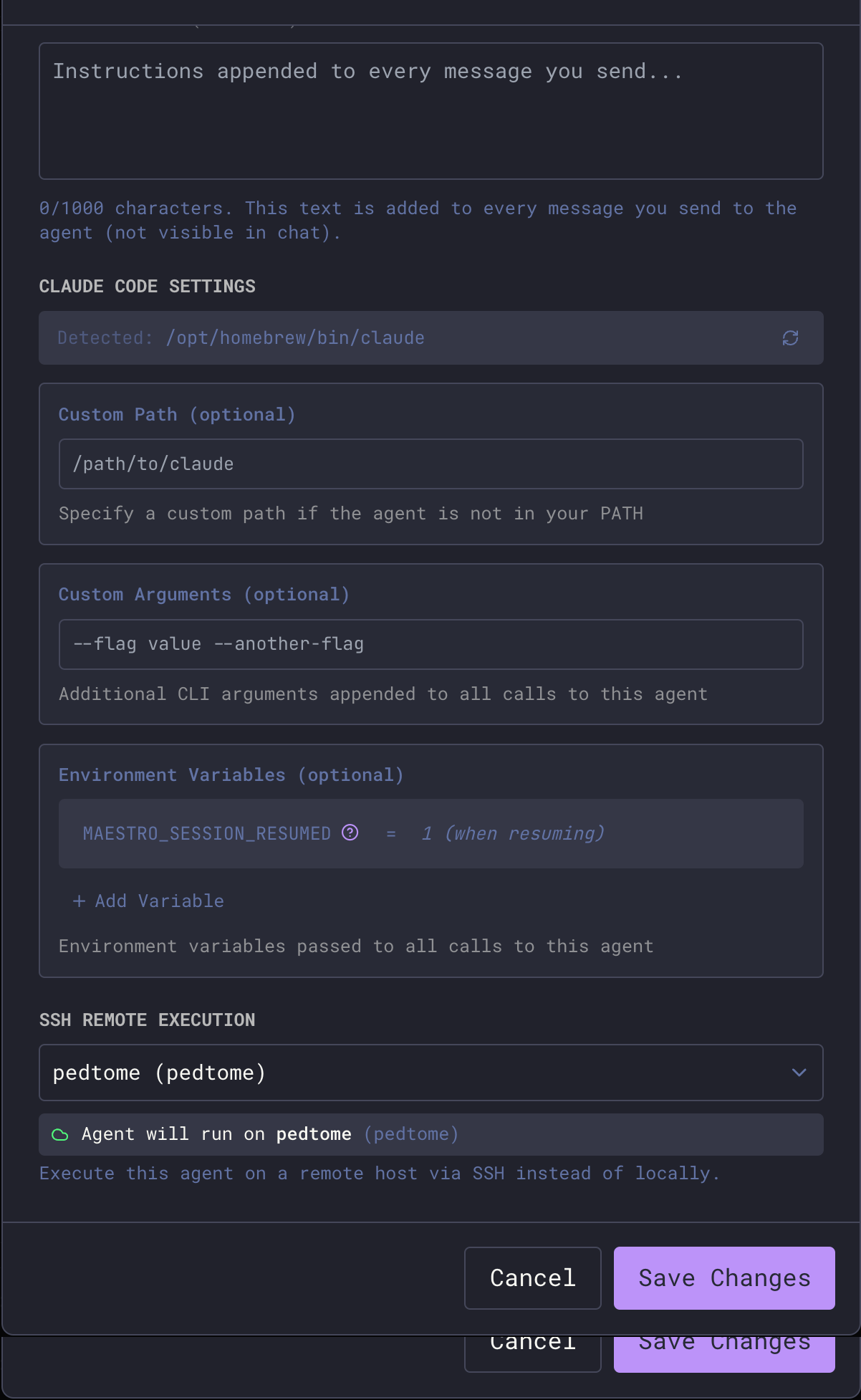
Each session can have its own SSH remote setting configured when creating the session or editing its configuration.Configuring a Session
- When creating a new agent session (via New Agent dialog or the wizard), find the SSH Remote Execution dropdown
- Select an option:
How It Works
SSH remote execution is configured at the session level:- When you create a new session, you choose whether it runs locally or on a specific remote
- The configuration is saved with the session and persists across restarts
- Each session maintains its own SSH setting independently
- Changing a session’s SSH remote requires editing the session configuration
Status Visibility
When a session is running via SSH remote, you can easily identify it: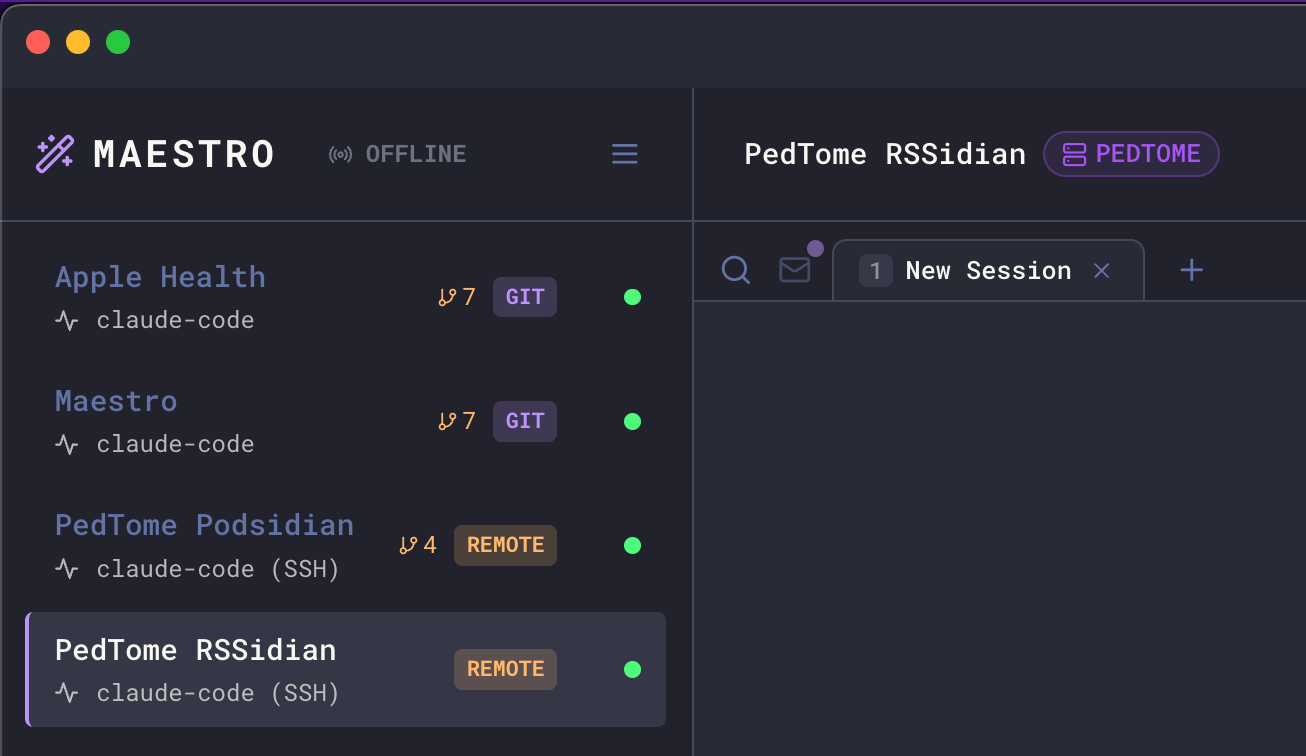
- REMOTE pill - Appears in the Left Bar next to the session, indicating it’s configured for remote execution
- Host name badge - Displayed in the Main Panel header showing which SSH host the agent is running on (e.g., “PEDTOME”)
- Agent type indicator - Shows “claude-code (SSH)” to clarify the execution mode
- Connection state reflects SSH connectivity
- Errors are detected and displayed with SSH-specific context
Full Remote Capabilities
Remote agents support all the features you’d expect from local agents:Remote File System Access
The File Explorer works seamlessly with remote agents:- Browse files and directories on the remote host
- Open and edit files directly
- Use
@file mentions to reference remote files in prompts - Compress a folder into a
.zipon the remote host (requireszipthere)
Remote Auto Run
Run Auto Run playbooks on remote projects:- Auto Run documents can reference files on the remote host
- Task execution happens on the remote machine
- Progress and results stream back to Maestro in real-time
Remote Git Worktrees
Create and manage git worktrees on remote repositories:- Worktree sub-agents run on the same remote host
- Branch isolation works just like local worktrees
- PR creation connects to the remote repository
Remote Command Terminal
The Command Terminal executes commands on the remote host:- Full PTY support for interactive commands
- Tab completion works with remote file paths
- Command history is preserved per-session
Claude Max Plan on Remote Hosts
Running a Claude Code agent against your Max plan quota (the TUI Wrapper and Dynamic token sources) relies on the maestro-p helper. It ships bundled with the desktop app for local agents, but over SSH the Claude TUI runs on the remote machine, so maestro-p must be on the remote host’s PATH. If it is missing, Maestro disables the Max plan options for that agent and falls back to the per-token API source. To enable Max plan billing on a remote host, install maestro-p from the maestro-p install page on that host, then click Re-check in the agent’s Claude Token Source panel.Group Chat with Remote Agents
Remote agents can participate in Group Chat alongside local agents. This enables powerful cross-machine collaboration: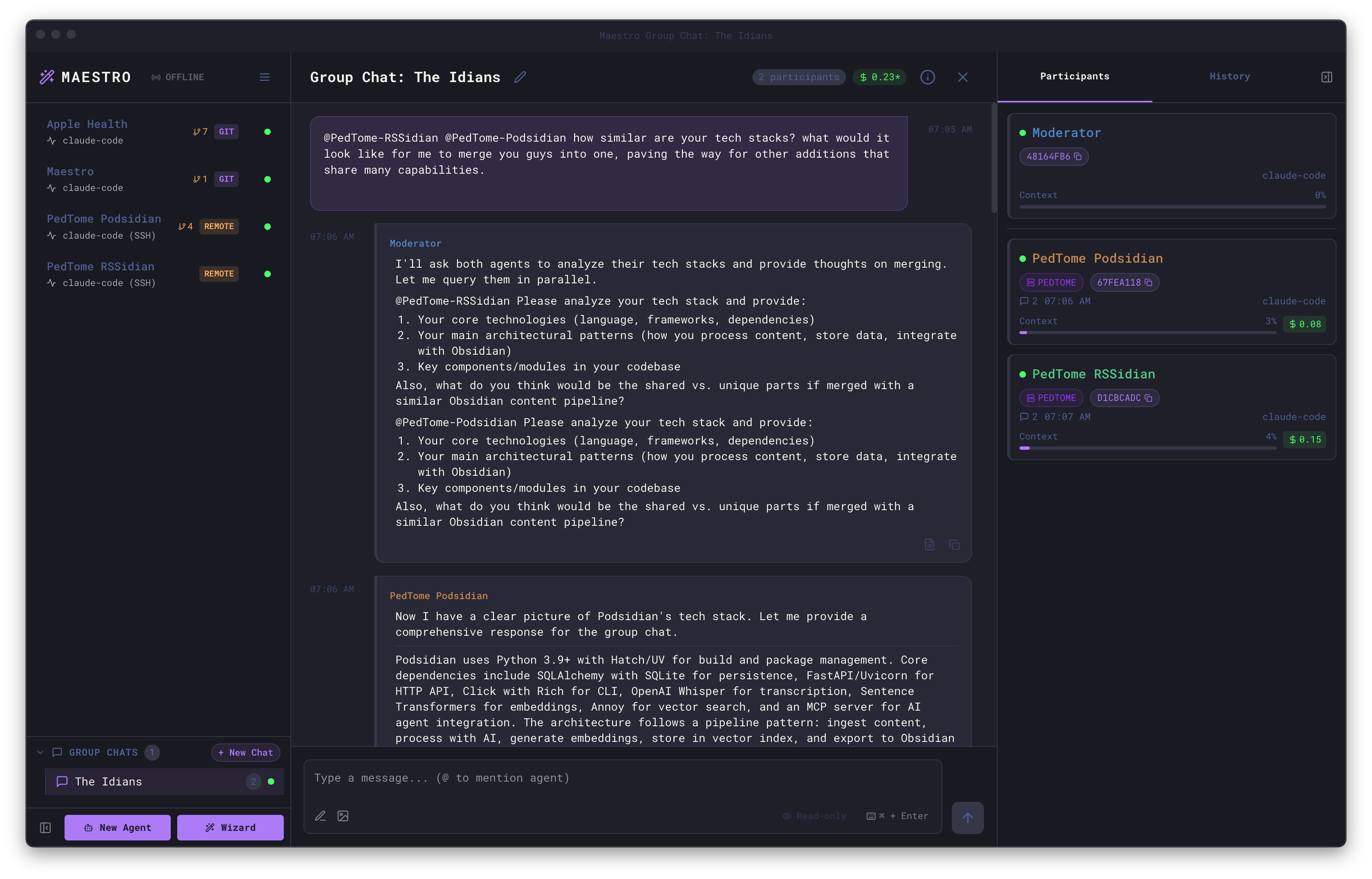
- Mix local and remote agents in the same conversation
- The moderator can be local or remote
- Each agent works in their own environment (local or remote)
- Synthesize information across different machines and codebases
- Comparing implementations across different environments
- Coordinating changes that span multiple servers
- Getting perspectives from agents with access to different resources
Windows Remote Hosts
Maestro drives a remote agent by piping a POSIX shell script into/bin/bash
on the remote: a PATH bootstrap, export VAR=..., then cd <dir> && exec <agent>. That means the remote’s default SSH shell must be a POSIX shell.
It does not have to be a Linux or macOS host; a Windows machine works fine once
it answers SSH with bash instead of PowerShell or cmd.exe.
Out of the box it does not. Windows OpenSSH ships with cmd.exe as its
DefaultShell, and most setup guides switch it to Windows PowerShell. Neither
can run the script Maestro sends, so every turn fails:
Maestro recognizes both. Test Connection reports
Remote SSH shell is Windows PowerShell (or cmd.exe) with the fix command attached, rather than a
raw parser dump, and a turn that hits this fails with the same guidance instead
of a generic crash.
Being able to
ssh into the host by hand does not mean Maestro can use it. An
interactive login and a piped non-interactive command are two different paths;
DefaultShell governs both, but only the second one needs POSIX.Pointing OpenSSH at a POSIX shell
Install Git for Windows (which brings Git Bash), then run this in an elevated PowerShell on the remote:bash.exe in System32:
bash.exe opens the default WSL distribution. DefaultShell cannot carry
arguments, so a value like wsl.exe -d Ubuntu does not work. To use a
specific distribution, make it the default instead:
wsl --set-default while signed in as the user Maestro connects as,
not as a different admin account. The agent runs as that distribution’s
default Linux user. To change that user, set default=<name> under [user]
in the distribution’s /etc/wsl.conf, then run wsl --terminate Ubuntu.
Restart the SSH service so new connections pick up the change:
SSH_OK then MINGW64_NT-10.0; WSL answers SSH_OK then
Linux. Either is good. A PowerShell parser error means the registry change
did not take effect - check that you ran it elevated and restarted sshd.
Git Bash or WSL?
Pick Git Bash when the project is a Windows project. Pick WSL when the project
is a Linux project that happens to live on a Windows machine. Do not mix: the
agent’s working directory must be reachable from whichever shell
DefaultShell
names.
After the shell is fixed
The rest of the setup is the same as any other remote:- Install the agent CLI so it is on the PATH of the shell you chose. Maestro probes the usual Node version-manager locations (nvm, fnm, volta, mise, asdf, n) but cannot find a binary that is only on the PowerShell PATH.
- Use forward-slash paths for the working directory (
/c/Users/you/project, notC:\Users\you\project). - Run Test Connection with the agent command filled in - it reports whether the agent binary was found, not just whether SSH works.
Collaborating over SSH
When multiple people (or the same person from multiple machines) work on a shared project via SSH, Maestro can synchronize history entries across all participants. This gives everyone visibility into what work has been done - regardless of which machine initiated it.How Shared History Works
Each Maestro instance writes a per-hostname history file to the project’s.maestro/history/ directory on the remote host:
- Each machine writes only its own file - no conflicts between writers
- When loading history, Maestro merges entries from all other hosts’ files
- Entries are deduplicated by ID and sorted by timestamp
- Remote entries appear with a ☁ Remote pill and the originating hostname in the History panel
Enabling Shared History
Shared history is enabled per-session via the Sync history to remote toggle, which appears in the SSH Remote Execution dropdown when an SSH host is selected:- Create or edit an agent session
- Select an SSH remote from the dropdown
- The Sync history to remote checkbox appears below the status indicator (disabled by default)
- When enabled, every history entry is written to both your local Maestro store and the remote project’s
.maestro/history/directory
Use Case: Same User, Multiple Machines
You have Maestro on your laptop (pedbook) and desktop (pedopswat). Both machines have an agent pointed at the same project on pedopswat:
- pedopswat runs the agent locally - history writes to its local store and
.maestro/history/history-pedopswat.jsonl - pedbook runs the agent via SSH to pedopswat - history writes to its local store and
.maestro/history/history-pedbook.jsonlon pedopswat - Both machines see each other’s entries when loading the History panel
Use Case: Team Collaboration on a Shared Server
Multiple team members (pedbook, stephan, mattj) each have Maestro installed locally and SSH into a shared VPS where the project lives. No Maestro is installed on the VPS - just the agent CLI:
- Each person’s Maestro writes to their own
history-<hostname>.jsonlon the VPS - Each person sees entries from all other team members
- Entries display the originating hostname so you can tell who did what
Entry Limits
Shared history files respect the Maximum Log Buffer setting (Settings → Display). Each hostname’s file retains up to this many entries (default: 5,000). When reading another host’s file, Maestro reads only the most recent entries up to your own buffer limit.Notes
- Shared history files use JSONL format (one JSON object per line) for safe concurrent appending
- Malformed lines are skipped gracefully - a partial write won’t corrupt the file
- If the SSH connection is unavailable when reading, local history is shown without remote entries (no error displayed)
- The
.maestro/history/directory is created automatically on first write - Consider adding
.maestro/history/to your.gitignore- history is operational data, not source code
Troubleshooting
Authentication Errors
Connection Errors
Remote Shell Errors
Agent Errors
Tips
- Import from SSH config - Use the dropdown when adding remotes to import from
~/.ssh/config; saves time and keeps configuration consistent - Bastion hosts - Use
ProxyJumpin your SSH config for multi-hop connections; Maestro inherits this automatically - Key management - Use
ssh-agentto avoid passphrase prompts - Connection multiplexing - Maestro respects
ControlMaster,ControlPath, andControlPersistfrom your~/.ssh/config. This is highly recommended if you use hardware security keys (e.g., YubiKey) to avoid repeated touches per connection. Example config:Make sure the socket directory exists (mkdir -p ~/.ssh/sockets). Use%h,%p, and%rtokens inControlPathto keep sockets unique per host/port/user. - Keep-alive - Configure
ServerAliveIntervalin SSH config for long sessions - Test manually first - Verify
ssh host 'claude --version'works before configuring in Maestro
Security Considerations
- SSH keys should have appropriate permissions (
chmod 600) - Use dedicated keys for Maestro if desired
- Remote working directories should have appropriate access controls
- Environment variables may contain sensitive data; they’re passed via SSH command line
Limitations
- Network latency affects perceived responsiveness
- The remote host must have the agent CLI installed and configured
- Some shell initialization files (
.bashrc,.zshrc) may not be fully sourced - agent commands use$SHELL -lcto ensure PATH availability from login profiles - The remote’s default SSH shell must be POSIX. A Windows host works, but only after its OpenSSH
DefaultShellpoints at Git Bash or WSL bash - see Windows Remote Hosts